
Thanksgiving is next week, and you may have invited friends and/or family to dinner. Of course, you’ll want to employ proper etiquette. I happen to own a little book, handed down from Pete’s grandmother and brown with age, titled Table Setting and Service for Mistress and Maid. It was written by Della Thompson Lutes, who is also billed as the author of The Gracious Hostess and A Home of Your Own, and Housekeeping Editor of Modern Priscilla and Director of Priscilla Proving Plant. In 155 pages, Mrs. Lutes outlines all the things the proper homemaker of 1928 needed to know about the art of furnishing a dining room, setting a table, hiring a maid (or waitress) and cook, and properly serving her family and guests.
Book
Embrace this Book
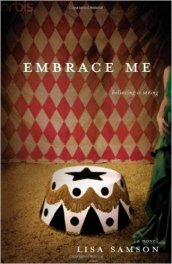 Redemption. Forgiveness. Love. Grace and mercy. With heady themes like this, you might get the impression that Embrace Me is a difficult and demanding story to read. You’d be wrong. Intense, yes. Emotional, absolutely. But author Lisa Samson’s easy style and authentic dialog make reading this book enjoyable, not laborious. In many ways it reminded me of The Shack, another work of fiction used to convey Biblical truth.
Good Answers for Hard Questions
You’ve heard it before:
- All religions are the same.
- Suffering is proof that God doesn’t exist.
- Christians are so narrow minded!
- Religion does more harm than good.
- A loving God would never send anyone to hell.
- Science has disproved Christianity.
- The Bible isn’t a reliable document.
You’ve run into these ideas in books or articles. They’ve issued from the mouths of friends or family members. You might even agree with some, or all, of them. Skepticism and atheism are oh, so trendy. Entire networks of blogs are devoted to dissing God and religion, usually with plenty of snide comments and a great degree of sarcasm. (I’ve often wondered why people get so snarky when it comes to criticizing other people’s beliefs.)
Book Review: Good or God
 This is the most significant book I’ve read all year.
Pete and I just spent a fabulous week in a lovely cabin in the Black Hills of South Dakota. Our aim was to stop, reflect, relax, and refresh. Some days we played tourist, enjoying the scenic drives, wildlife, and golden aspen and cottonwoods. Other days we hung around the cabin, reading, talking, and praying. After a crazy year that included moving both our home and Pete’s ministry office, it was just what we needed.
I had a stack of books to read, and managed to make it through several of them. They were all excellent, but if I could pick one to recommend most highly, it would have to be Good or God: Why Good without God Isn’t Enough, by John Bevere.
In Search of a Good Book
Monday was Labor Day, and I wanted to take it easy. It had been a packed week, it was time for a break, and I desperately wanted to collapse into a recliner for several hours with a good book. The only problem was, I couldn’t find one I wanted to read.
There are lots of non-fiction books out there and I have several that I’m currently wading through, but this was a holiday and I wanted to escape into an exciting, well-written page-turner. Since the library was closed, I turned to their online collection. (I love that you can choose and download a book from home!)

Read This Book. Understand Muslims.
 When you consider Muslims, what comes to mind? A terrorist? A suicide bomber? Or perhaps a woman swathed in a black burka? How about the family next door, or your college professor, or perhaps the engineer in the next cubicle?
Because many Americans don’t personally know anyone who is a Muslim, our mental image may not match reality. Sure, some Muslims are terrorists, but many more are our neighbors and business associates—and perhaps our friends.
If you’d like to go beyond the front page news stories and discover how the “average” Muslim thinks, (if there is such a person), I highly recommend that you read The Crescent through the Eyes of the Cross: Insights from an Arab Christian, by Dr. Nabeel T. Jabour. If you’d like to know how Muslims view Christianity, then I recommend this book even more highly. And if you want to move past stereotypes and fear and learn to love our Muslim neighbors, then get your hands on this book as soon as possible! Continue reading
Are you too busy? Make time to read this!
 I read a good book last week: Women Who Do Too Much: How to Stop Doing It All and Start Enjoying Your Life, by Patricia Sprinkle. I chose this book because I met the author at our yearly ministry retreat. She was both interesting and engaging, and I expected the same from her writing. I wasn’t disappointed.
As you might expect, this book focuses on ways to declutter your life. Unlike many of the time management solutions available, Sprinkle’s advice is based on Scripture—she starts and ends with prayer and the word of God. This is advice you can trust.
Book Review: The Torn Veil
Christian church bombed in Nigeria. Muslim convert disowned by family.
We read the headlines, and try to imagine, but it’s very difficult to understand what it’s like to be in their shoes. We love to complain about the demise of Christianity’s cultural acceptance here in the U.S., but we really have no idea what it’s like to lose our home, our family, or our life for our faith.
One way to overcome this barrier is to read Christian biographies. The dialogue may be fictionalized, but the stories are true. As we immerse ourselves in the book, we begin to identify with the main character. What happens to them? How do they react? How would we react in the same circumstances?
Do You Have Financial Faith?
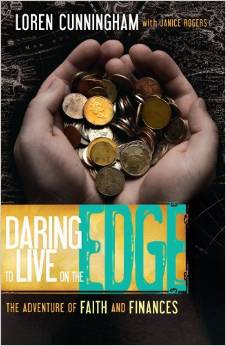 Have you made your New Year’s resolutions? Are you vowing that this year you’re going to diet, exercise, and be more responsible with your finances? I can’t help with the diet and exercise part, but I can recommend a must-read book on finances. It’s Daring to Live on the Edge: The Adventure of Faith and Finances, by Loren Cunningham.
There are a lot of books out there on managing your money. They all contain pretty much the same advice—follow a budget, spend less than you earn, don’t go into debt. If the author is a Christian, then there’s an additional focus on tithing, generosity, and putting God first.
With All Your Mind
 When asked (in Matthew 22:36-38) which is the greatest commandment in the Law, Jesus replied “‘Love the Lord your God with all your heart and with all your soul and with all your mind.’ He was quoting Deuteronomy 6:5, but with a twist—Jesus added the word “mind.”
There’s a reason for this. When Deuteronomy was written, the concept of mind was included in heart and soul. By the time Jesus arrived on the scene, those meanings had diverged. Wanting to be sure that we understood our need to love God with our intellect, Jesus inserted the extra word. (And while Matthew omitted “with all your strength,” Mark and Luke made sure to include it.)
 Compost