How to Grow a Houseplant—Food and Water

PrintFeeding
Most potting mixes have fertilizer already added to them, so you won’t need to worry about feeding your plants for the first three to four months. Once that fertilizer is used up, it’s time to add more. You can use any commercial fertilizer sold for houseplants.

Your choices are really a matter of personal preference. Some fertilizers are powders or liquids that you add to your watering can. Others are time-release pellets you incorporate into the potting mix. Some of these are considered organic, others are not. I’ve used a wide variety of products: liquid concentrates, powders, time-release pellets, fish emulsion—and even my homemade “worm tea” (the diluted run-off from my worm composting bins). It all works fine.

Mix your fertilizers according to the package directions. More is not better—you’ll burn your plants. I’ve found that mixing fertilizer at half-strength and applying it twice as often gives good results. If you notice white minerals accumulating on the plant’s container, run some water through the potting mix to flush out the build-up of fertilizer salts. Be sure to let the pot drain thoroughly afterwards.

Continue reading

How to Grow a Houseplant

spider-plant_home_20090908_lah_0280“Mom, can you fix it?”

My college freshman was looking at me with a dejected, mournful expression. She was holding the spider plant I had sent to school with her. It looked awful. Wilted, brown leaves hung limply over the edge of the plastic pot. There were no signs of life.

“Well, that one looks kind of done, but I can give you another one. I’ve got plenty of spider plants. What happened?”

The story unfolded… it was below freezing outside, but the heat in the dorms was turned way up. Suffocating in her room, she’d opened the window a crack. No one thought to move the plant on the windowsill. Unfortunately, spider plants aren’t equipped to survive six degree drafts. The poor plant had frozen during the night.

As I potted up another victim, er, spider plant for my daughter, I realized that while our house is full of greenery, I’d never taught our kids how to care for any of it. Here today, and for the next two Fridays, is how to grow a houseplant.

Continue reading

How to Fold a T-Shirt

Does anyone really like doing laundry? Not me, no way. Hauling the dirty clothes downstairs, sorting (Pete doesn’t appreciate pink underwear), putting it all into the machine (thank you God for a washing machine!), schlepping it over to the dryer, and later rushing back downstairs to grab things before they wrinkle enough to need ironing (Ironing? What’s that?)—definitely not my favorite way to spend time.

My least favorite laundry chore is emptying the dryer and folding the clean clothes. I already washed them—they’re clean!—you mean there’s more? (I also hate putting away clean dishes.) And (in my mind) the most annoying clothes to fold are t-shirts.

Mostly, we hang t-shirts up in the closet. Hanging tends to stretch the neck a bit, but it’s so much easier, it’s worth it. However, Pete’s undershirts would take up too much closet space, so they get folded up and shoved into a drawer.

Folding undershirts has become a bit less tedious since Pete found this video on YouTube: How to Fold a T-Shirt in 2 Seconds. You still need to unstick the shirt from itself and get it more or less neatly laid out, and that’s still a pain. But then you’re home free. Try it—it works.

Computer House Cleaning

Today’s terrific advice comes from Pete (click on any photo for a bigger version):

When mom said “clean your room,” I often thought “why bother — it’s just going to get messy again anyway!”

But what about computers? Do home computer boxes need tidying up?

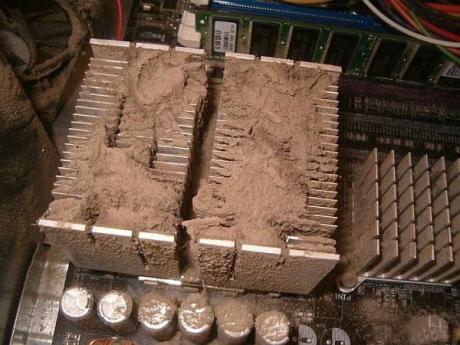
pc-dustThey sure do! That horrible mess of thick dust in the picture isn’t just a hidden eyesore: it can be the cause of some very expensive repairs. Built-up dust will cause your computer to use more power, to overheat, and ultimately the dusty grime will slow overload the fan motor(s) and burn them out. A burnt-out fan, if you are lucky, “only” needs replacing. But if the computer overheated due to the lack of fresh air, you might end up replacing far more expensive and valuable parts: your hard disk, the main board, or the power supply. That’s no fun at all. Note: this applies to both PC’s and Mac’s. No gloating, folks.

Continue reading