How to Grow a Houseplant—Potting

A pet bird has a cage and a gecko has a terrarium. Plants need a special places to live too.

You have a lot of latitude in choosing a container for your plant. Consider not only made-for-plants pots, but other bowls, cans, and even shoes. However, there are a few requisites.

Drainage is paramount. If your chosen pot doesn’t have a drain hole, add one.

Size matters too. The larger the container, the longer it can go between waterings. Larger containers are also more stable. And large containers provide plenty of root space. However, you need to match the container size to the plant that will occupy it.

Another consideration is container shape. I once had a lovely pot that was smaller at the top than in the middle. It looked great—until it was time to move my plant to a bigger home. Then I realized there was no way to extract the roots without damaging them.
Continue reading

A Better Carrot Cake Recipe

After a summer of salads, the cooler weather has me wanting to bake again. Autumn always makes me think of the color orange, and what is more orange than carrots? I really like this recipe for carrot cake because it is chewy and moist but not greasy. The sugar content is under control, and you don’t need frosting—a dusting of powdered sugar is enough to give it a finished look. Try making it for your small group meeting or as the finale to a special dinner.

Continue reading

How to Grow a Houseplant—Food and Water

PrintFeeding
Most potting mixes have fertilizer already added to them, so you won’t need to worry about feeding your plants for the first three to four months. Once that fertilizer is used up, it’s time to add more. You can use any commercial fertilizer sold for houseplants.

Your choices are really a matter of personal preference. Some fertilizers are powders or liquids that you add to your watering can. Others are time-release pellets you incorporate into the potting mix. Some of these are considered organic, others are not. I’ve used a wide variety of products: liquid concentrates, powders, time-release pellets, fish emulsion—and even my homemade “worm tea” (the diluted run-off from my worm composting bins). It all works fine.

Mix your fertilizers according to the package directions. More is not better—you’ll burn your plants. I’ve found that mixing fertilizer at half-strength and applying it twice as often gives good results. If you notice white minerals accumulating on the plant’s container, run some water through the potting mix to flush out the build-up of fertilizer salts. Be sure to let the pot drain thoroughly afterwards.

Continue reading

Vintage Friendships

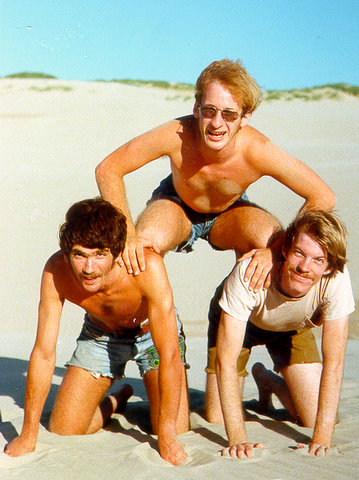
1977-mikepetedave-pyramidWe looked like a bunch of middle-aged geezers, heading out to the local park. Fair enough—that’s what we are. As college roommates and best friends in the mid-70’s, we’ve been around for quite a while. For the most part, while we’ve kept in touch somewhat, we hadn’t seen one another in ages. Pete and I live in Colorado, Dave lives in Portland, and Corinne and Mike are an hour apart near Seattle. And while we had sworn that we’d always be friends, life has a way of distracting you from your best intentions.

I had been anticipating this reunion for weeks, as soon as I found out I’d be accompanying my sweetie on his business trip to Portland. Now, at last, we had all converged on Corinne’s house for the weekend, and here we were—all together again.

Continue reading

How to Grow a Houseplant

spider-plant_home_20090908_lah_0280“Mom, can you fix it?”

My college freshman was looking at me with a dejected, mournful expression. She was holding the spider plant I had sent to school with her. It looked awful. Wilted, brown leaves hung limply over the edge of the plastic pot. There were no signs of life.

“Well, that one looks kind of done, but I can give you another one. I’ve got plenty of spider plants. What happened?”

The story unfolded… it was below freezing outside, but the heat in the dorms was turned way up. Suffocating in her room, she’d opened the window a crack. No one thought to move the plant on the windowsill. Unfortunately, spider plants aren’t equipped to survive six degree drafts. The poor plant had frozen during the night.

As I potted up another victim, er, spider plant for my daughter, I realized that while our house is full of greenery, I’d never taught our kids how to care for any of it. Here today, and for the next two Fridays, is how to grow a houseplant.

Continue reading

Budgeting Your Organic Dollars

There are two piles of apples in the produce section of my market. The first, at $2 per pound, are grown conventionally. The other pile, at twice the price, have been grown organically. Which apples should I buy?

Every time I go to the market, I have to make the decision whether or not to buy organic. If my food budget was unlimited, it would be easy. Organic farming is better for the planet. It’s better for the field workers. And it’s better for the consumer. But organic food is also more expensive. Given that our family is on a strict food allowance, I need some sort of criteria to help me decide when to spend extra and when to buy the cheapest available.

Happily, a bit of searching came up with a list of commonly purchased food items, and their average pesticide load when grown by conventional farmers. You can find it at the Environmental Working Group’s website.

Seeing that apples score among the highest produce items for pesticide load, I’ll definitely spring for the organic ones. Onions and peas, however, are traditionally grown without a lot of spraying, so I’ll stick to the cheapest ones I can find.

I think I’ll print out this list and stick it in my wallet for my next trip to the market.

I Love Chocolate

I love chocolate. I admit it. I’m one of those people you could find wearing a T-shirt reading, “Hand over the chocolate and nobody gets hurt.” It’s definitely one of the major food groups. I could hug the scientist who named the cacao plant Cacao theobroma—literally, “chocolate God-food.”

There has been plenty of research now indicating that chocolate (sans the sugar) is actually good for you, but a little more encouragement can’t hurt. I recently read an article containing the phrase, “The incidence of fatal heart attacks correlated inversely with the amount of chocolate consumed.”[1] In other words, eating chocolate reduces your chances of dying from a heart attack. Pass the Toblerone!

Continue reading

Come Away with Me

come-away-with-meHow much time have you spent alone with God lately? In the midst of our busy schedules, it’s easy to overlook His still, small voice calling out to us for attention. I know I find it extra hard to set aside a regular date with God when my calendar is full of camping trips, hikes, and other summer activities that disrupt my routine.

Sometimes, what we really need is a kick-start, a prolonged time to really quiet ourselves and listen. When Pete has been traveling a lot, we try to plan an overnight get-away aimed at reestablishing our connection with one another. It takes more than just an hour or two at a local restaurant. Longer absences need longer dates. It’s the same way with God. When we’re extra busy, that’s when we especially need to set aside time with Him.

Continue reading

How to Fold a T-Shirt

Does anyone really like doing laundry? Not me, no way. Hauling the dirty clothes downstairs, sorting (Pete doesn’t appreciate pink underwear), putting it all into the machine (thank you God for a washing machine!), schlepping it over to the dryer, and later rushing back downstairs to grab things before they wrinkle enough to need ironing (Ironing? What’s that?)—definitely not my favorite way to spend time.

My least favorite laundry chore is emptying the dryer and folding the clean clothes. I already washed them—they’re clean!—you mean there’s more? (I also hate putting away clean dishes.) And (in my mind) the most annoying clothes to fold are t-shirts.

Mostly, we hang t-shirts up in the closet. Hanging tends to stretch the neck a bit, but it’s so much easier, it’s worth it. However, Pete’s undershirts would take up too much closet space, so they get folded up and shoved into a drawer.

Folding undershirts has become a bit less tedious since Pete found this video on YouTube: How to Fold a T-Shirt in 2 Seconds. You still need to unstick the shirt from itself and get it more or less neatly laid out, and that’s still a pain. But then you’re home free. Try it—it works.

Should I Marry You?

2a6t1253Are you in love? In a serious relationship? Considering marriage? Dreams of white dresses and romantic honeymoons are plenty distracting. But don’t let your hormones run your life. It pays to work through some hard issues before making any permanent decisions.

I strongly recommend premarital counseling. It has been proven to increase both your marital happiness and the strength of your commitment to one another.[1] But in addition to meeting with a pastor or taking a class at church, try investing some time working things through on your own.

Plenty of books, workbooks, and articles are available to give you a reality check on your connubial dreams. John Piper has written an outstanding list of questions to consider. I was so impressed, I had to post a link to it.

Working through this list will give you plenty to talk about and consider. Even after thirty years of wedded bliss (well, mostly), Pete and I still discuss many of these issues. Pick one or two and make an evening out of it. Sure beats watching reruns on the talking box.


[1]Journal of Family Psychology